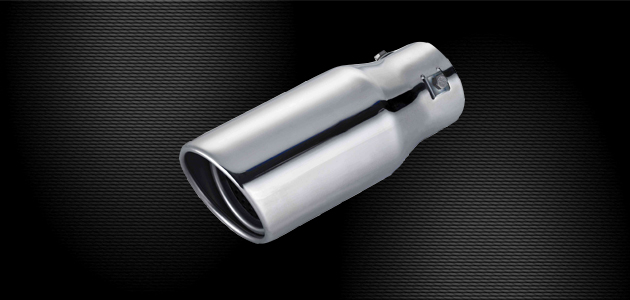
Basic principle and structural composition of muffler.
Muffler refers to an airflow duct with noise propagation, which can use pipes and elbows with sound-absorbing lining, or pipes with sudden changes in cross-sectional area and other sound resistance discontinuities to attenuate or reflect noise inside the duct.
Most people know, a few know.
When it comes to sound waves, we need to explain the mechanism of their generation: we need to briefly introduce sound.
The three elements of sound are: sound source, propagation, and reception. Communication relies on media such as air, water, and steel pipes; The sound source is an object that stimulates media vibration, such as engine exhaust emissions or exhaust pipe vibration; Ears are receiving devices.
Media vibration produces sparse and dense regions of molecules, which are commonly referred to as sound waves (similar to water waves). The distance between adjacent densely populated areas (or sparse areas, where you can place your hand on the muffler outlet area and feel the pressure intermittently increase and decrease, large dense areas, small sparse areas) determines the frequency of sound waves. The longer the distance, the lower the sound frequency (bass), and the shorter the distance, the higher the sound frequency (treble). In GT analysis, the frequency of exhaust noise generally does not exceed 1000 Hz (the accuracy of GT decreases when the noise frequency exceeds 1000 Hz), below 100 Hz can be considered as bass, 100 to 300 Hz can be considered as midrange, and above 300 Hz belongs to treble, which is different from the normal music classification of low, medium, and treble. The size of sound is expressed in decibels. The normal speech sound of people is about 60-70 decibels, and the sound of F1 racing cars can reach 10-10 decibels.
The cause of noise.
Firstly, understand how the engine works. The common four stroke engine has four working stages: 1- intake, 2- compression, 3- ignition, and 4- exhaust. In the adjacent two exhaust processes, there are three other working stages, so the gas pressure in the exhaust pipe is discontinuous. The discontinuous gas pressure leads to sparse and dense areas of gas molecules, which is the same as the sound generation mechanism mentioned above.
Characteristics of exhaust sound waves.
The exhaust sound wave is divided into two parts: one part is related to the periodic rotation of the engine, called the rank sound; The other part is the flow of exhaust gas, which is then emitted into the air, called the sound of airflow. The enchanting sound waves pursued by modified exhaust are the class sound. In order to highlight the voice of class, it is necessary to reduce the sound of airflow. The usual method is to use sound-absorbing cotton to absorb sound, thicken the exhaust tailpipe, and reduce the exhaust flow velocity, thereby reducing the sound of airflow.
Class voice can be divided into many parts. According to the different cylinders of the engine, the names of the class sounds are also different. For example, 4-cylinder engines correspond to 2nd, 4th, and 6th order engines, while 6-cylinder engines are divided into 3rd, 6th, and 9th order engines. Professional exhaust sound design usually records and analyzes exhaust sound through professional equipment to obtain color spectrograms. Taking the color spectrum of exhaust sound waves from a 4-cylinder engine as an example:
Blue represents low sound, red represents high sound, the horizontal axis represents sound frequency, and the vertical axis represents engine speed. The yellow spots in the figure represent the airflow sound, such as the exhaust sound band from 1200 to 1500 hertz. The diagonal lines in the range of 50 to 450 Hz in the figure represent infrasound. A clear diagonal line is 2nd order; The second one is 4th order, etc. Generally speaking, low and strong exhaust sound waves are concentrated in the first two orders (i.e. 2nd and 4th orders). The high-definition and crisp exhaust sound waves are concentrated at higher stages (6, 8, 10, 12 or even higher).
How to control exhaust sound waves?
Silencers are mainly used to regulate exhaust sound waves. According to the working principle, mufflers can be divided into resistance, resistance, and composite types.
Resistance muffler: The working principle is to use sound-absorbing cotton to absorb sound. As the name suggests, sound obstruction is achieved by filling the muffler with porous sound-absorbing materials, converting sound energy into internal energy and consuming this energy. However, it has good high-frequency noise reduction effect but poor low-frequency noise reduction effect. Why is it like this? It can be considered that high frequencies can eliminate most of them, while low frequencies are less effective. I think if the low-frequency part is obstructed, more sound-absorbing cotton can be added, but of course, the addition of sound-absorbing cotton is limited. Commonly found in intermediate mufflers and direct mufflers at the rear, resistance mufflers mainly operate at mid to high frequencies.
Resistance muffler: As the name suggests, a resistance muffler is mainly composed of a partition and an expansion chamber to eliminate different wave and resistance principles of the resistance muffler (also known as a reflection). A typical muffler has three expansion chambers of different sizes. By utilizing the reflection of exhaust gases in these chambers and mutual interference (friction), the soundproofing effect is achieved. The suppression effect on mid low frequency noise is very significant. The structure is discontinuous, and sound is reflected in these discontinuous structures to reduce sound. Resistance mufflers mainly operate at mid to low frequencies.
Composite muffler: As a combination of resistance and resistance muffler, it can achieve full frequency band noise reduction. However, most people often mix airflow and sound, thinking that changing the direction of airflow can change sound, which is not entirely correct. For example, a simple example is that due to the obstruction of the sound-absorbing cotton, most of the airflow flows along the inner tube, while some sounds can easily penetrate into the sound-absorbing cotton quilt through the holes on the inner tube. If the diameter of the outer shell of the resistance muffler increases sufficiently, the airflow direction will still flow along the inner tube, but basically all the sound will be absorbed by the sound-absorbing cotton, so even if it is directly discharged, a certain amount of noise can be eliminated.
Exhaust resonance can be divided into two types: sound resonance (also known as resonance) and vibration resonance. The vibration of the exhaust pipe is caused by the vibration generated by the engine operation (which can be referred to as the sound source). Bellows can be installed at the connection to reduce the vibration transmitted to the middle and rear parts, which is equivalent to a spring damping system. A well-designed corrugated pipe can reduce most of the vibrations propagating along the exhaust pipe.
Any object has a fixed vibration frequency, and exhaust pipes are no exception. In addition, the vibration size of each part of the object also follows a regular pattern, with some areas experiencing small vibrations and others experiencing large vibrations. When fixing the muffler in the equation, we should also find the correct position and not place it in areas with high vibration (such as the front and rear warehouses of FSCC racing cars). We can also install corrugated pipes between the exhaust pipe and muffler to reduce vibration frequency and change the natural vibration frequency of the exhaust pipe. The vibration of exhaust noise will be amplified and driven by the frame to vibrate the vehicle. When the frequencies of two vibration functions are the same, the amplitudes will be superimposed, and therefore the vibration will be amplified. Therefore, a suitable position should also be found when installing the muffler.
Sound resonance is the medium required for vibration propagation. Vibration resonance is caused by the consistency between engine vibration and the inherent characteristics of exhaust pipe structure. The propagation medium of exhaust sound waves is air, so sound resonance is caused by the inherent characteristics of the engine's exhaust sound waves and the air in the exhaust pipe. During the propagation process, exhaust sound waves will form standing waves in the exhaust pipe, which differ in the amount of vibration at different positions of the exhaust pipe. Due to the presence of standing waves, the magnitude of sound in the exhaust pipe also varies depending on its position. Usually, the points and positions of sound vary depending on the frequency of the sound. For example, the sound point of standing wave 1 is located in the middle of two mufflers, while the frequency of standing wave 2 is twice that of standing wave 1. When the frequency of the exhaust sound wave of the engine is consistent with the standing wave frequency of the connecting pipe, sound resonance will occur. The same resonance means that the vibration will be amplified.